Monday, February 21, 2011

Renewing solidarity

Renewing solidarity

James Turley reports on the annual conference of Hands Off the People of Iran

The recent revolts in Egypt, Tunisia and many other parts of the Arab world have had a profound effect on global politics. Given the enormous strategic importance of the region, all manner of political forces will try to turn events to their advantage. The need for principled anti-war and solidarity work has never been greater.

It was thus a good time for Hands Off the People of Iran to hold its annual general meeting - there is the possibility of the ‘north African contagion’ reaching Iran, with the explosive popular movement against Ahmadinejad that sprung up in 2009 standing as a portent.

Discussions on the day were wide-ranging. Hopi secretary Mark Fischer started proceedings with a report on our work over the last year. Comrade Fischer pointed out that we had not been the only ones to salute the 2009 protests - we welcomed the apparent overnight conversions of Campaign Iran, the Socialist Workers Party and others from slavish support for the regime to some degree of solidarity. Nonetheless, we had warned against tailing the ‘reformist’ leaders of the green movement; a perspective confirmed by the “dissipation and betrayals” of 2010. With the regime divided, the US and its allies have pounced, imposing ever tougher sanctions - and open warfare, perhaps waged by the US’s Israeli proxy, should not be ruled out.

Hopi has responded to these developments. Comrade Fischer noted that, in the past year, the focus of our solidarity work has shifted from student protestors to workers. The working class in Iran is increasingly militant, and economic demands have begun to interweave with political ones. All this confirmed our basic perspectives of opposing war, opposing the theocracy and supporting the working class and its allies as the only consistently anti-imperialist force in society.

Comrade Fischer noted the increasing desperation of the Stop the War Coalition in its efforts to prevent Hopi affiliating, and suggested we draw up a “balance sheet” of our involvement with it. He noted the impact made by our solidarity campaign with the imprisoned film-maker, Jafar Panahi, stating that we should make him into a symbol for all political prisoners in Iran.

Much discussion from the floor focused on the question of Stop the War. Charlie Pottins said that we had tended to identify the politics of the coalition with that of the SWP - but now it was more dominated by the Communist Party of Britain. However, Andrew Coates noted that the latter had been affected to an extent by the Iranian protest movement.

Another comrade suggested that we should try to see things from Stop the War’s point of view - since its aim was to build broad opposition to the war, open criticisms of the Iranian regime may not be appropriate. Moshé Machover replied to this, saying that we have not attempted to commit the STWC to any such position - it was the fact that Hopi was openly critical of the regime which seemed to animate their hostility. John Bridge went further - the fact that we had been turned down for affiliation gave the lie to the coalition’s claims of inclusiveness. He noted that the rejection of our application had been filmed by Press TV, the English-language channel owned by the Iranian state.

International context

The second session of the day was on ‘Wikileaks, whistleblowers, revolution and war’. Comrade Machover opened the session by talking about the recent series of leaks relating to the Middle East - most prominently, the Wikileaks-released batch of American diplomatic cables, but also the work of whistleblowers in both the Israeli military and the Palestinian Authority. He claimed that these revelations were a case of “the dog that didn’t bark” - they merely clarified what we already knew.

Crucially, these leaks confirmed that Israel has been involved in a sustained, guerrilla-style campaign against Iran, encompassing espionage, sabotage and outright assassinations. Several scientists working on Iran’s nuclear programme have been killed - so, possibly, has former deputy defence minister Ali-Reza Asgari, who disappeared in Turkey under mysterious circumstances.

An equally significant feature of the Wikileaks cables was what was not revealed - most importantly, there is no more evidence that Iran actually plans to produce nuclear weapons. Comrade Machover considered it more likely that Iran was aiming for nuclear capability - ie, the infrastructure required to produce weapons at some later date - than an arms programme proper.

Moving on to the question of revolution, comrade Machover indicated the momentous significance of the upheavals in Egypt and elsewhere, placing them in the context of the decline of the US, which is already losing control in Latin America. The Middle East is a critically important region in the world, due to its oil reserves and shipping routes. Egypt has been the key country in the Arab world in recent history - not only is it the most populous country in the region, but it controls the Suez Canal. Not for nothing was the 1956 Suez crisis a key turning point in relations between the major imperialist powers.

The US has been caught off guard, and can hope to recoup some of its control, but not the overwhelming influence it enjoyed with Mubarak in the top job. For Israel, meanwhile, Mubarak’s overthrow is a very dangerous proposition. It has already lost a key ally in Turkey, which was finally confirmed by the Mavi Marmara massacre last year. Now Egypt may go too - and Egyptian acquiescence has been critically important for maintaining the siege on the Gaza Strip. The Israel Defence Force has benefited from troop redeployments away from the Egyptian border; should Egypt present a less friendly face in the future, even the already bloated military budget will prove insufficient.

Comrade Machover concluded by pointing out that the losers in international reconfigurations can behave in unpredictable ways, and that we should not rule out even the most counterproductive and irrational of military adventures on Israel’s part. We must remain vigilant.

The second speaker in this session, the CPGB’s Mike Macnair, focused more on the American angle. The events in Egypt and Tunisia are best characterised as a “revolutionary crisis” rather than a revolution - though the dictators have fallen, the general feeling is that “this is just the start”. The US therefore still has some room for manoeuvre. It has gone into this crisis underprepared, rather than unprepared - it is not like the fall of the shah in 1979, which by all accounts came as a complete surprise to the US.

The US has some reason to suppose that it will succeed in restoring its influence in these countries. Under Jimmy Carter, it successfully dropped most of the military dictators it supported in Latin America, with the result that the new ‘democracies’ were even more reliant on international capital than the tyrants they replaced - the state department simply bought off those parties that had a chance of power.

This is why, despite the lack of smoking-gun revelations, it was the release of diplomatic cables that provoked the US into its full-scale attacks on Wikileaks. In order for bourgeois democracy to function in this way, it is necessary for governments to lie - and to lie, it is necessary to maintain secrecy.

Comrade Macnair argued that the policy of the United States towards Israel has always been irrational. The US relies on Iran to provide any workable regime in Iraq; more generally, the disruption caused by constant sabre-rattling and sanctions is much greater than the disruption which would be caused by a deal with the Islamic regime. Taking into account the inherent irrationality of a superpower in decline, there were “irrational reasons” for us to expect war - but revolutionary crisis in the Middle East has at least had the effect of throwing all these tendencies temporarily up in the air.

After some debate, the conference passed - with minor amendments - a resolution reaffirming our opposition to imperialist intervention in Iran and support for the democratic struggles of the Iranian people.

Workers in Iran

The next session was centred on workers’ struggles in Iran. Ruben Markarian of the Iranian group, Rahe Kargar, began his contribution by pointing out two anniversaries - the overthrow of the shah on February 11 1979, and the formation of the Fedayeen guerrilla organisation in early 1971. The 1979 revolution had ultimately been a loss for the left, and the protestors in Egypt must learn the lessons of that defeat.

The protests in 2009 had ushered in a new era in the Iranian revolution, but it has not reduced the Iranian state’s repression. In particular, there is an execution every eight hours in Iran - some resulting from openly political charges, some for ‘crimes against Islam’, and others simple frame-ups. The regime’s desperation is heightened by the crippling effects of sanctions, and the popular unrest at its own policies, such as the end of ‘targeted subsidies’ and mass lay-offs.

Street demonstrations, he argued, cannot win alone. Demonstrators must be backed up by the workers’ movement, which can organise strikes against the regime - crucially, a general strike. Strikes can materially disrupt the repressive actions of the state, as well as causing the security forces to overreach in attempting to respond to all threats. Creating such a movement is easier said than done, but it is necessary. The job of the Iranian left is to organise the mass of workers on a socialist and internationalist basis. The comrade was confident that the Egyptian masses would learn from the Iranians - and vice versa.

Hopi chair Yassamine Mather highlighted the similarities between the Egyptian unrest and the protests in Iran two years ago. Both had been preceded by significant outbursts of labour unrest. Prior to 2009, however, Iranian workers had concentrated on narrower economic issues, concerning working conditions at particular factories. The organised working class was late to the party in 2009 - and this, combined with the misleadership of the green ‘reformists’ and organised battalions of counterrevolutionary thugs, emboldened by religious ideology, meant that the protests ended in defeat.

Since then, however, the workers have been raising more political demands, including the issue of political prisoners, and even organising the first political strikes since 1979-81. Workers at the Iran Khodro car manufacturing concern, as well as the traditionally militant oil workers, had been engaging in serious discussion about the value of strikes, the nature of the green movement and the shora (workers’ councils). Comrade Mather concluded by echoing Markarian’s point on the significance of the Fedayeen - it was the first time in the Middle East that a section of the left had rejected the peaceful road to socialism, as well as highlighting the importance of internationalism.

Debate was largely centred on the international response to the 2009 protest movement, with comrades commenting on the support offered to Ahmadinejad by Venezuelan president Hugo Chávez, British anti-war figurehead George Galloway and the American leftist journal, Monthly Review. The importance of Islam in the protest movement was also highlighted. Summing up, comrade Mather noted that Chávez’s support had led to splits on the left, notably in the International Marxist Tendency, whose Iranian section had departed over the issue. Comrade Markarian also criticised Chávez for his support for the Islamic Republic. The meeting then unanimously passed a motion calling for solidarity with Iranian workers.

Political prisoners

Then followed the launch of Hopi’s campaign in defence of political prisoners. Lisa Goldman introduced the session by talking about her experience in Iran, and her contact during the visit with Panahi, concluding by reading from a letter he sent to the Berlin International Film Festival - an eloquent plea for an end to tyranny and testimony to the power of artistic imagination in opposing it.

Leftwing Labour MP John McDonnell launched the campaign formally, applauding the success of Hopi in engaging people on its basic message. The threat to Iran continues - sanctions and the Stuxnet cyber-attack being the most visible manifestations of it at the moment - though the imperialist world has been less forthcoming in bellicose rhetoric. Acts of barbarity, it seems, are fine, as long as the west is unthreatened.

He echoed Mark Fischer’s call to make Panahi a symbol for all political prisoners, and argued that we should canvass for support in every sphere of life - in parliament, of course, but also in the trade unions (where Hopi has already had some success, with unions like PCS and Aslef affiliating). The stature of Panahi allows us also to reach out to wider civil society, and argue for its greater involvement with the workers’ movement. The upsurge in Egypt symbolises what is possible in Iran - meanwhile, if our campaign secures even one release of one political prisoner, comrade McDonnell argued, it will be worth it.

In the following discussion, Victoria Thompson argued that we should add a call for an end to executions to the statement, which was accepted by the meeting. We also resolved to challenge Jeremy Corbyn to end his involvement with Press TV.

Though relatively small, the meeting was high-spirited. We left optimistic that our work can be stepped up, and that more people can be engaged in support of our message.

Thursday, February 17, 2011

Revolution spreads to Iran

Revolution spreads to Iran

Yassamine Mather reports on the effects of the Egyptian upsurge

As early as Sunday February 13 riot police and the bassiji militia took up positions in the main streets of Tehran in preparation for the demonstration called for the following day. ‘Reformist’ leaders Mir-Hossein Moussavi and Mehdi Karroubi were put under house arrest and internet connection to many sites was blocked.

Then, as darkness fell, all over Tehran people went onto their rooftops, shouting, “Allah-o-akbar” (God is great) and “Marg bar dictator” (Down with the dictator).

Videos of the night-time demonstration appeared quickly online and by the morning of Monday February 14 many Iranian were aware that anti-government protests were taking place. Tehran residents were surprised to find that mobile phones were working (they had been blocked at around 4pm the previous day) and protestors could organise routes, points of assembly …

However, even taking into account all these positive signs, no-one could have predicted the size and extent of the demonstrations - the most significant anti-government protest since security forces cracked down on a series of massive events in 2009. Indeed, a leaked document from the pro-Khamenei Islamic parliament security committee puts the number of Monday’s protestors in Tehran at one million.

Revolutionary guards used tear gas, wielded batons and opened fire to disperse protestors, yet large numbers gathered, particularly in central and poorer districts of Tehran. The majority of the demonstrators were young working class men and women. There were clashes between police and demonstrators, and dozens of arrests, in Isfahan, Tabriz, Shiraz, Mashad and Rasht.

Iranians had been frustrated for weeks, as they witnessed demonstrations in Tunisia, Egypt and elsewhere in the Middle East. Young Iranians were convinced their protests of summer of 2009 had inspired these demonstrations. Many were arguing why, in comparison with Egypt, their own larger demonstrations then (three million in Tehran alone) had failed to overthrow the regime, when smaller protests led to Hosni Mubarak’s departure. There had been an element of despair, although the events in Tunisia and Egypt had certainly put to rest claims made throughout 2009 and early 2010 by leaders of the green movement, as well as by the reformists of the ‘official communist’ Tudeh Party and Fedayeen Majority, that the ‘era of revolutions is over’, that one should be realistic and demand the ‘possible’: ie, reform within the regime.

Other apologists for the Iranian regime, such as the Socialist Workers Party’s Elaheh Rostami-Povey, must also feel embarrassed by recent events in Arab capitals, as well as in Tehran. Her recent book, entitled Iran’s influence across the Middle East and the world, is described by her SWP comrade, Alex Callinicos, as a “fascinating study of the evolution of the Islamic Republican regime in Iran, of its complex and increasingly conflictual relationship with popular and social movements, and of its impact on the wider Middle East. This fine product of Elaheh Rostami-Povey’s critical scholarship is essential reading for anyone who refuses to settle for mythological and demonising representations of post-revolutionary Iran.” The author claimed that Iran’s clerical regime and its president has considerable support in the “Arab street”.

Amongst the many protests in Egypt and Tunisia not only were there no signs of support for the Islamic Republic, but protestors in Tahrir Square called on Iranians to follow their example and continue their protests for democracy. Indeed every time Iran’s rulers tried to imply that Arab protestors were following in the traditions of the revolution led by ayatollah Ruhollah Khomeini, secular and religious protestors united to denounce such comparisons. The reaction of Iran’s Islamic rulers was predictable: they jammed Al Jazeera TV’s broadcasts to avoid ‘revolutionary contamination’.

Last week Iran’s Islamist hardliners’ desperate efforts to downplay the democratic thrust of the Egyptian revolution and present it as an Islamic, Iran-inspired uprising backfired, when even the Muslim Brotherhood protested at this falsification. By February 14 worse was to follow (for the regime). Tens of thousands of Iranians were shouting: “Mubarak, Ben Ali - Seyed Ali - it’s your turn” (referring, of course, to supreme leader Seyed Ali Khamenei alongside the departed rulers of Egypt and Tunisia). Other prominent slogans were “Khamenei - buy a one-way ticket out of Iran”; and “Poor Seyed Ali - the movement is still alive” (referring to Khamenei’s claims that the opposition had now gone away).

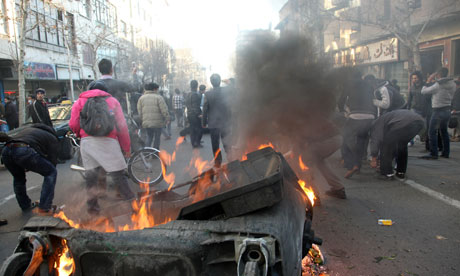
In central Tehran large posters of Khomeini and Khamenei were torn down and set on fire. As night fell, youths gathered in many neighbourhoods and set fire to bins. Despite the fears of the days preceding February 14, the protests were a huge success. According to eyewitness Hamid Farokhnia, a staff writer at Iran Labour Report, “People were smiling with joy for the first time in a long while. Likewise, many bassiji and [police] officers looked positively confused and crestfallen.”

A day after the street protests members of the Iranian parliament called for opposition leaders Karroubi and Moussavi to be prosecuted and sentenced to death for stirring unrest. Despite this, Moussavi’s spokesperson called the protests a major success and did not condemn the anti-Khamenei slogans, as was the case on previous occasions. While the ‘reformists’ have evidently not joined the revolution, this shows just how far the movement has been radicalised. Unlike in 2009, there is now a clear and unambiguous call for the overthrow of the entire regime.

After months of despondency, optimism has returned. Students and workers we contacted were enthused by this week’s events, even though some opposition groups believe up to 1,500 people have been arrested during the protests. In fact two were killed and in a Kafkaesque attempt at falsification the regime claimed 26-year-old Sane Jaleh, killed on February 14, was a member of the bassiji. Sane’s friends have posted photos of him alongside the dissident ayatollah, Hussein-Ali Montazeri, who died in 2009, to prove that he was in fact a Moussavi supporter.

Acting police commander general Ahmad Reza Radan said dozens of people, including nine members of the security forces, had been injured. It is true that in a show of confidence protestors attacked a number of bassiji - Radan might yet regret exaggerating the protestors’ success in confronting security forces.

Monday, February 14, 2011

Egyptian success inspires protesters

Iranian opposition leader Mousavai and his wife were stopped today and their car keys taken from them as they tried to join protestors today in Tehran city centre. The state authorities have unleashed the riot police and tried to shut down people’s access to the outside world in the hope of hiding the growing fever for protest.

It was rumoured that the Iranian state authorities had taken the former prime minister of Iran and placed him under house arrest alongside Mehdi Karroubi.There have been attempts to quickly and quietly pull the two opposition leaders from public view in light of the upcoming anniversary of street protests in Iran after the disputed re-election of Ahmadinhad in 2009. Many people were killed and a media blackout resulted to hide the turmoil from the rest of the world. The President Mahmoud Ahmadinejad now has a lot to fear after seeing Egyptian dictator Mubarack dramatically pulled from power by the people. The success of the Egyptian people has inspired people to take to the streets in other countries creating fear in their governments.

In 2009 thousands took to the streets at the re-election of Ahmadinejad with the encouragement of Mousavei and those in the Green Movement. Ahmadinejad won the presidential election even though his rival Moussavei had proved to be more popular with the voters and many commentators doubting the results because of the incredible speed of the ballot slips returned. However the strength of Iran’s Revolutionary Guard quickly crushed the protestors and since then the lack of dissent has been visible but with an increase of imprisonment for those who speak out.

Ahmadinejad a clever leader of media spin and with his grip on the national media stated that the fall of Mubarack was similar to the fall of the Shah in 1979 and with no sense of irony has previously compared the opposition leaders to Adolf Hitler. He is unlikely to comment about the imprisonment in his own regime of trade union leaders, women lawyers and activists being tortured, beaten and killed. Even the Egyptians have stated that they are baffled by his comparison with the Egyptian foreign minister stating that Ahmadininejad was ‘distracting the Iranian people's attention by hiding behind what is happening in Egypt.’

Even at this point with one eye on the streets of Tehran Ahmadinejad has the other on the new Egyptian State in the hope of cementing relations with the new authorities.  Recently a trade agreement between Iran and Turkey was announced increasing political and business ties as the continuation of US sanctions is hurts the state. The fallout of the Egyptian’s dictatorship will leave Ahmadinejad and his followers ready to crush similar action and looking for allies. Ahmadinejad is aware that it’s not just the American vultures ready to criticise and attack the country in an Iraqi-style swoop taking its resources but concerned protestors are ready including exiled Iranians declaring the right to protest. All eyes will be on the opposition in the coming weeks fighting for freedom. Today one person has been killed, three injured and hundreds of protestors arrested by the riot police. Let the ripples of the Egyptian revolution spread but without the creeping hands of imperial powers stealing from Iran and its people.

Saturday, January 29, 2011

Amadinejad slapped as factions turn on each other

Amadinejad slapped as factions turn on each other

Yassamine Mather looks at the growing tensions in the Islamic regime

Last week's stalemate in nuclear talks between Iran and the so-called 'five plus one' countries (US, China, France, Russia, Britain and Germany) came at a time when a number of events had already promised a turbulent start to the new year for Iranians: a plane crash for which sanctions must have been partly responsible; the execution of 53 prisoners, including four political prisoners, in less than three weeks; accusations by the 'principlist' faction of the regime that president Mahmoud Ahmadinejad's closest ally, chief of staff Esfandiar Rahim Mashaei, is an "agent of foreign powers" (Israel); that vice-president Rahimi is corrupt; stories that Ahmadinejad was slapped in the face by a revolutionary guard commander; confirmation that Israel and US jointly sponsored the Stuxnet computer worm; the escalation of US sanctions against Iranian shipping companies; Afghan protests over Iran's month-long near blockade of cross-border fuel shipments; the passing of harsh sentences against film maker Jafar Panahi, 'human rights' lawyer Nasrin Sotoudeh and journalist Shiva Nazar Ahari; and a wave of workers' strikes demanding the release of all political prisoners ...

Seventy-five people were killed on January 9 when an Iran Air flight with 105 passengers and crew aboard crashed near Orumiyeh in north-western Iran. The US-made Boeing 727 plane, bought 37 years ago, broke into pieces when it attempted to make an emergency landing in a snowstorm near Orumiyeh in Iranian Azerbaijan. The incident led to a spontaneous anti-sanctions campaign when a Facebook page got the support of 25,000 Iranians - US sanctions prevent Iran from purchasing new aircraft and spare parts. Iran's ageing civilian air fleet (and, one assumes, military aircrafts) use spare parts bought on the black market or taken from older aircraft. In 2005 the International Civil Aviation Organisation warned that sanctions on Iran were "placing civilian lives in danger" by denying Iranian aviation the necessary spare parts and aircraft repair, and the situation has inevitably become worse in the last few years.

Following the accident, transport minister Hamid Behbehani, still in denial about the effect of sanctions, said that the number of aviation accidents in Iran was low compared to the world average. The Iranian press and media derided Behbehani's statement. Farda, a website associated with one of the conservative blocs, claimed that the minister's remarks showed complete disregard for public concern over the unacceptable number of aviation accidents. The website said that Iranians killed in plane crashes in the past 30 years made up nearly 30% of the world's total aviation accident fatalities (1,610 out of 5,416 people killed) - 795 people had been killed in the past seven years alone, about 23% of the global total in the same period.

Corruption

Throughout the Middle East and North Africa, where corruption is characteristic of secular, pro-western governments, Islamists claim to lead the battle against it (and overconsumption), at times pointing to Ahmadinejad as their champion. However Iranians are well aware that, for all his election promises of combating corruption, Ahmadinejad presides over one of the most rotten governments Iran has experienced - and this is quite an achievement, given the depth and spread of corruption during the Rafsanjani/Khatami presidencies, not to mention the pre-1979 Pahlavi era.

Allegations of corruption against first vice-president Mohammad-Reza Rahimi were first published by the conservative 'principlists' in April 2010. They claimed to possess evidence proving Rahimi was the ringleader of a corruption band known as the 'Fatemi circle'. Eleven people implicated in a government-linked embezzlement case are already in jail awaiting trial. A number of prominent conservative MPs have called for Rahimi be put on trial as well. Last week, in an open letter to chief justice Ayatollah Sadegh Larijani, Ahmad Tavakoli wrote: "Is it fair that a low-ranking defendant in the Iran Insurance Company case ... should be jailed … when [Rahimi] is not even indicted?"

There are also allegations that the first vice-president spent large sums of government money bribing legislators to vote for a government bill when he was the parliamentary liaison deputy. Had it not been for the fierce internal battles between various factions of the Islamic regime, all this would have been forgotten, like many similar allegations. However, last month, the prosecutor general, Gholam-Hossein Mohseni Ejei, confirmed that Rahimi faced charges of corruption that needed to be investigated and, of course, if he is put to trial this would indicate a major shift in policy. According to journalists inside Iran, it would signify that the supreme leader, Ali Khamenei, has finally decided to stop giving his entire support to the president and ignore the complaints of the principlists.

Clearly the infighting between the Ahmadinejad and conservative camps has risen to a new level in recent months. They disagree on every subject from foreign policy to nuclear development and economic policies, from the never-ending issue of women's headscarves to cultural freedoms. However, the conservatives have chosen Ahmadinejad's seemingly unconditional support for Rahimi and Mashaie as the battleground.

'Liberal' Ahmadinejad?

According to Wikileaks documents released on December 31, at a meeting of Iran's supreme national security council (SNSC) held in early 2010 to discuss steps in dealing with protests, Ahmadinejad surprised other SNSC members by taking up a liberal posture. According to sources quoted by Wikileaks, Ahmadinejad claimed that "people feel suffocated" and argued that in order to defuse the situation it may be necessary to allow more personal and social freedoms, including more freedom of the press. The source claimed Ahmadinejad's statements infuriated Revolutionary Guard chief of staff Mohammed Jafari, who said: "You are wrong! It is you who created this mess and now you say, give more freedom to the press?!" Allegedly Jafari then slapped Ahmadinejad in the face, causing an uproar.

Of course Iran's Revolutionary Guards have subsequently denied the report. However, even if one doubts the veracity of the slapping incident it is certainly true that the conflict within the state has now engulfed various factions of Iran's militia and, like members of the majles (Islamic parliament), they are expressing their disapproval of Ahmadinejad's new-found liberal and nationalist (as opposed to Islamic) posturing in the open.

Perhaps it was inevitable that, faced with major demonstrations and envious of the apparent popularity of the nationalist reformists, Ahmadinejad would try and steal their policies. In this he has relied heavily on the controversial opinions of chief of staff Mashaei (to whom he happens to be related).

Mashaei was first vice-president of Iran for one week in July 2009. His appointment was heavily criticised by the hard-line conservatives and he resigned following the direct intervention of Khamenei. Today Mashaie is still under attack for his unorthodox religious views and for allegedly influencing the president's decisions in other matters, including the appointment and firing of cabinet members.

Mashaie belongs to a group that believe the return of the 12th Shia Imam is imminent, while senior Shia clerics are opposed to such views, as 'nobody knows when the imam will return'. Mashaei has also expressed controversial views about an 'Iranian school of thought', as opposed to an 'Islamic school of thought', about the hijab, the religious ban on music and more recently about cultural freedom.

In fact on most of these issues, in particular the emphasis on Iranian nationalism, he and Ahmadinejad echo the views of the 'reformist' leaders, Mir-Hossein Moussavi and Mohammad Khatami. All this because Ahmadinejad is apparently grooming Mashaie to be his successor in the 2013 presidential elections - alarming news for conservative hardliner and senior ayatollahs.

Mashaei controversies

Over the last few years Mashaie has been blamed for a number of comments and incidents considered unacceptable by Ahmadinejad's enemies, who have been busy compiling them:

  • July 2008: Mashaei is quoted as saying: "Today, Iran is a friend of the United States and Israeli nations. No nation in the world is our enemy. This is an honour." For the first time since the 1979 revolution, an Iranian regime politician acknowledged the Israelis as a nation. In response 200 MPs released a statement calling for Mashaei to be "dealt with seriously" and ayatollah Khamenei denounced his remarks in Friday prayers. The day before, Ahmadinejad had said that Mashaei's opinions were also those of the government.
  • November 2008: In Iran, opening ceremonies for public events almost always begin with the recitation of a few verses of the Qur'an by a qari (reciter). The reciter of the international conference on investment in Iran's tourism industry had to wait for the Qur'an to be delivered to him by women dressed in Kurdish traditional clothes playing frame drums (dafs). Two senior clerics from Qom were outraged at the incident, but Mashaei blamed his deputy, who was subsequently sacked.
  • September 2009: At the inauguration of the minister for higher education, Mashaei told the audience: "God ... created the human ... if the human were removed, there is no need to remove god." While it is not clear exactly what this meant, it was considered blasphemous by senior clerics.
  • November 2009: The hard-line newspaper, Kayhan, quoted Mashaei as saying: "God cannot be the fulcrum of unity for humankind". The paper commented that his remarks were "unjustifiable" and paved the way for malicious propaganda.
  • January 2010: Following Mashaei's presence at a photo exhibition with actress Hedieh Tehrani, there were rumours that she was his mistress (as opposed to his sigheh - a Shia 'temporary wife') and that the Organisation of Cultural Heritage had loaned her $200,000 for the event. Mashaei claimed that the picture taken of him sitting side by side with Tehrani had been doctored to make the two appear intimate. The actress denied rumours that Mashaei had bought one of her most expensive photo works. However, the incident prompted some bloggers to compare the "scandal" with the "decadence" of the last years of the shah's rule.
  • July 2010: Mashaei invited a number of Los Angeles-based Iranian singers - most of them from the pre-Islamic Republic era - back to Iran. Supporters of the supreme leader slammed Mashaei, claiming that he wanted to "invert the situation" (favour supporters of the monarchy). Mashaei had said that expatriate Iranian singers would have no problem returning to the country if their activities were legal.
  • August 2010: In a speech at the Razi Medical Research Festival, Mashaei said that the 'god-sent prophet' Noah failed to undertake a "comprehensive management style" since he did not establish justice. He reiterated similar remarks regarding other prophets in his subsequent speeches.
  • August 2010: In the closing ceremony of a conference of expatriate Iranians, Mashaei made what was perhaps his most controversial remark to date: "Some criticise me for refusing to talk of the school of Islam and instead preferring the school of Iran. There are diverse interpretations of Islam, but our perception of the essence of Islam is the school of Iran, which we should promote to the world." Former head of the judiciary ayatollah Mesbah Yazdi accused Mashaei of parroting the words of monarchists, while general Hassan Firouzabadi, joint chief of staff of the Iranian armed forces, went further, claiming the remarks were an act against national security, and an attack on the tenets of the Islamic Republic and the Islamic Revolution. Yazdi threatened: "If someone turns away from Islam, we warn him, and then, if that does not work, we beat him."

Conservative cleric Ebrahim Nikoonam referred to the "possibility that the 'incitement' created by the presidential chief of staff might be rooted in foreign agendas". Previously, some high-ranking officials had insinuated that Ahmadinejad's office had been infiltrated by a foreign state (this is usually taken to mean Israel). Nikoonam said: "Such words might be said by those who are not part of the government, but when they are said by those who are they cause serious concern." Yazdi called on Ahmadinejad to "beware of letting anyone infiltrate the government who might later turn out to be an agent of foreigners".

Pure theatre

On January 11 theatregoers queuing outside Tehran's City Theatre to watch Henrik Ibsen's Hedda Gabler were informed by police that the play, which had been running for a week, had been suspended.

One of the play's characters is a former alcoholic, but in the Tehran production there was no mention of alcoholism, and male and female characters were kept away from each other on stage. However, the Fars News Agency reported that conservative papers had claimed the theatre was promoting "nihilism, licentiousness and vulgarism as the main points of the play", which has "nothing to do with national and Islamic ideas and is based on western nihilistic philosophy".

All artistic activities in Iran are controlled and regulated by the ministry of culture and Islamic guidance, and the Iranian version of Hedda Gabler had apparently passed its vetting procedures following changes to the original script imposed by the censor. The subsequent news that a new body to regulate cultural affairs was to be created came amid a very public row between the ministry of culture and the regime's more conservative elements. Culture minister Mohammad Hosseini said there was "no moral issue" with the play and accused its critics of "exaggeration", while Mashaei himself used the incident to reassert Ahmadinejad's new-found 'reformist' credentials.

Mashaei also commented that Ahmadinejad was not in favour of the jailing of renowned filmmaker Jafar Panahi. Panahi was handed a six-year prison sentence and a 20-year work ban for making propaganda against the Islamic establishment. The work ban covers writing scripts, film-making and travel abroad, as well as giving interviews to local and foreign media. Mashaei added: "The sentence was issued by the judiciary and reflects neither my opinion nor that of the president."

Crisis? What crisis?

The history of Iran's Islamic regime has been one of permanent crises and constant conflict between various factions of the regime. However, over the last 30 years they have agreed to share power in accordance with their respective votes in elections (the choice being limited, of course, to factions of the Islamic Republic) and subsequent negotiations. Last year's rigged presidential elections broke this pattern and for the first time since 1979 there is no precedence for resolving the current conflict. Hence the paralysis that has overtaken decision-making and the total uncertainty regarding the forthcoming majles poll. In December, former president Mohammad Khatami warned that 'reformist' parties would not take part in future elections "unless prisoners are freed and the elections are clean".

The battle lines for 2011 have already been drawn, with unprecedented animosity not just between conservatives and 'reformists', but more significantly within both groups. It is important to emphasise that these divisions are expressions of the inability of the religious state in its entirety to rule the country. The current crisis of government - mainly between the president, his advisers and ministers, on the one hand, and the conservative principlists in the majles and revolutionary guards, on the other - has brought the state to a standstill and it is unlikely that this crisis, coinciding as it does with the escalation of sanctions, will be resolved as easily as previous ones.

For example, the appointment of the governor of Iran's central bank has become a battleground between the warring factions. The majles voted in November in favour of a bill authorising a change in the composition of the bank's board to block government "interference" and ensure its "independence". The bill effectively removed the president's executive control over the central bank, highlighting the intensity of the infighting between parliament and government at a time of discontent over price rises, the ending of subsidies and mass unemployment. Parliament, strengthened in recent months by the backlash against the crippling impact of the latest round of UN sanctions, seemed to have wrested day-to-day control of monetary policy from the government, but Ahmadinejad simply refused to accept the bill, creating deadlock.

In another development, the ministry of foreign affairs has barred Tehran's mayor, Mohammad Qalibaf, from attending an awards ceremony in Washington in an attempt to prevent a rival to the Iranian president from gaining international publicity. The inability of the regime to agree on peaceful coexistence between its factions has led to renewed speculation about regime change through military intervention by one section of the Revolutionary Guards against another or through the US escalation of sanctions combined with cyber war and armed insurrection amongst national minorities.

Iranians have been looking at events in Tunisia with envy and websites have compared the success of the protests in overthrowing Ben Ali's government with the failure of larger, more militant protests last year in Iran to achieve similar results. Answering the question, "Why Tunis, not Iran?", one cartoonist sums up the feelings of frustration and anger amongst young Iranians: "Moussavi talks about the 'golden years' under Khomeini, Karroubi is nostalgic for the 'dear imam', Khatami supports velayate faghih [religious guardianship of the nation], Rafsanjani addresses Khamenei as the 'dear leader' ... Now do you get why Ben Ali fled and Seyyed Ali [Khamenei] is still in power?"

In the words of Mohammad Reza Shalgouni, a leading comrade of Rahe Kargar, the Organisation of Revolutionary Workers of Iran, "The situation in Iran is such that even the resolution of a most modest demand, that of the position of a headscarf a few millimetres above or below the woman's eyebrow, cannot be resolved by 'reform'. Such a simple demand requires a revolution."

At a time when leaders of the green movement have reached a dead end, their failure is also that of their leftwing supporters. A recent battle between Farrokh Negahdar, a leading figure of the Fedayeen Majority, and other members of that organisation's central committee shows the bankruptcy of both sides. Negahdar was criticised for the content of his open letter to Khamenei, which could have been written, word for word, by Hashemi Rafsanjani or any other leading 'reformist' supporter of the supreme leader. It warns Khamenei that he will lose power unless he listens to the calls for reform!

Although the letter is an appalling text, it is difficult to understand the anger of other members of Majority Fedayeen central committee. After all, what Negahdar has written is the inevitable consequence of the policy advocated by that organisation for more than a decade of tailing Islamist 'reformists'. No doubt Negahdar's text is shameful, but so are the policies of all those who advocate accommodation with a wing of this brutal religious dictatorship.

Friday, November 12, 2010

Sanctions take their toll

Sanctions take their toll

Yassamine Mather calls for international solidarity with Iranian workers

Over the last two weeks the number of strikes in Iranian factories and workplaces has risen considerably. Workers have taken action in major plants such as South Pars Gasfields, Alborz Lastic Sazi, Ghaem Shahr textiles, Safa Louleh (pipe manufacturers), as have city council workers in Abadan. Demands have also been raised by nurses and other hospital workers, teachers and civil servants.

Some of the most important oil and gas plants have been hit, as well as key manufacturing industries. In other words, both the traditional and modern sectors. In addition to these strikes, we have also seen the first protests by retired workers opposed to a reduction in price concessions for pensioners, reduced from 15% to 9%. Retired employees demonstrated outside the majles (Islamic parliament). In some ways this was as important as the strikes by workers in employment.

How should we analyse the fact that so many workers’ protests have occurred simultaneously? Is it just a coincidence? Of course, it is impossible to predict how things will evolve, but, given the level of repression against workers and the left, these events mark a significant development in the current stage of economic and political struggles inside Iran. So what are the factors behind this new wave of labour unrest?

There is no doubt that sanctions are creating widespread economic devastation, to a degree that is unprecedented over the last 30 years. The drop in the price of oil on the world market, the reduction of production levels for both oil and gas (itself a result of the failure to renew productive capacity), the fall in non-oil exports, bankruptcies and closures in production and manufacturing, the rise in the rate of inflation in housing and essential goods, the plunder of the country’s economic resources through the expropriation of privatised industries and services by factions of the regime, the colossal rise in the price of medical services and drugs - all this points to an escalation of the economic and social crisis.

By November 9, long queues were forming at petrol stations, as motorists expecting a 400% price rise were trying to fill up their tanks. But low-paid workers are the main victims of the current situation. According to an employee of Ghaem Shahr Textile Industries, many of his colleagues have been forced to remove their children from education (both high school and university) so that they can feed their families on the meagre income from their temporary jobs.

Many small and medium-sized firms have already been bankrupted. However, what we are witnessing now is the effects of the crisis on some of the country’s major industrial units, exposing the extent of the problems facing the whole economy. In the past the Islamic regime could rely on oil income and unbridled imports to deal with the demand for basic consumption goods. But now the ruling elite is faced with two important problems: a fall in the price of oil and a regime of suffocating sanctions.

The new round of sanctions has not only made it difficult to import many items, leading to spiralling price rises for most goods: it has also become a serious political weapon threatening the survival of the regime. The regime cannot ignore the problems of production in major industries and this has given the workers in such plants an opportunity to raise demands regarding wages and working conditions.

All this has occurred at a time when the government has been pushing through the abolition of price subsidies - or promoting ‘targeted subsidies’, as it prefers to say. Despite threats to punish shopkeepers who increase prices charged for essential goods, such as bread, meat, sugar, cooking oil and dairy produce, prices for these items are rising daily. Compared to last year, the cost of bread is likely to have increased five or six times by the end of this Iranian month, while cooking oil will have more than doubled and cuts of lamb tripled.

This week, after months of denial, Iran’s Central Bank admitted the true extent of the rise in the rate of inflation. Statistics issued by the bank and other government organisations, including for the cost of living, are given in dollars, even though Iranian workers are paid in tomans (1,000 tomans = one dollar). Last week the price of imported meat in Tehran supermarkets was $30 a kilo - more than in most stores in London or New York. The average wage is $400 a month.

We should not forget that the removal of subsidies on essential food items was part of a $100 billion cuts programme; an integral component of the regime’s adherence to neoliberal economic policies under the terms of its five-year plan. However, uncertainty over the changes was one of the factors behind a $6 billion slide in the value of Tehran’s stock exchange two weeks ago, with trade volume plummeting 63% and share prices dropping by 43% in just one week.

All this will inevitably lead to increased unemployment. Official figures put Iran’s jobless rate at 14.6%. However, this is far below the true figure. The government of president Mahmoud Ahmadinejad has revised the definition of what constitutes unemployment a number of times. Currently someone doing just one hour of paid work per week is not considered unemployed. But no-one doubts that for many the prospect of finding a job is non-existent.

The government’s fear of food riots following the abolition of subsidies is so real that even before the deadline for full implementation it stationed special military units in poor districts to ‘maintain security’ - in other words, prepare for potential confrontation with the masses. The police presence in Tehran and other cities was also increased and many were deployed on major streets and outside supermarkets. Meanwhile, the Revolutionary Guards’ Tehran commander announced that a special task force has been formed to deal with any economic protests. On November 8, several underground rap musicians were arrested in Tehran, and last week hundreds of young men and women were detained in what the police termed a “security cleansing”. The press has been warned to steer clear of any controversial coverage of the subsidy cuts.

In working class districts, everyone is clearly worried about Ahmadinejad’s plans for ‘reforming’ the economy. Of course, a combination of workers’ protests and riots in shanty towns would be a nightmare for the Islamic regime, but the key element is the strength and organisation of the working class. Given the weakness of the left, we cannot expect the working class to be in a position to take full advantage of the current situation. However, there is no doubt that in these exceptional times the success of the shanty towns struggles, the defeat of the abolition of subsidies and the struggles of pensioners all depend on the proletariat.

As in 1979, Iranian workers are in a position to make their mark in the fight against poverty and exploitation and for democracy. In pursuing these goals they need international solidarity and it is part of the role of Hands Off the People of Iran to mobilise such support.

Thursday, October 7, 2010

Sanctions siege turns into cyberwarfare


The Stuxnet virus is a new form of warfare. Instead of Iran being attacked by planes and missiles it has been USBs. Yassamine Mather reports

While Israel, the US and Britain keep up their rhetoric of ultimatums and threats against Iran, and escalate the siege warfare of economic sanctions, Hands Off the People of Iran has been warning of the very real and ominous danger of a so-called pre-emptive attack. Now things have taken an unexpected and dangerous turn. Throughout the last couple of months Iran’s nuclear plants as well as a number of major industrial complexes have been targeted by a sophisticated piece of malware: Stuxnet.

According to computer experts the virus’s complexity suggests it was written by a “nation state” and it is the first known worm designed to target not software, but real-world infrastructure such as power stations, water plants and industrial units. Last week, after many denials, Iran confirmed that 30,000 computers in the country’s power stations, including the nuclear reactor in Bushehr, had been attacked by the virus, blaming Israeli or American spies for infiltrating the plant.

A total of 40,000 computers worldwide are known to be affected by the virus. According to Liam Ó Murchú, manager of operations with Symantec’s security response team, “It’s amazing, really, the resources that went into this worm”. It is suggested that the virus was introduced to Iran not through the internet but on a memory stick, possibly by one of the Russian firms helping to build the Bushehr nuclear plant. The same firm has projects in other Asian countries, including India and Indonesia, which were also attacked. But Iran is thought to have suffered 60% of the attacks.

Stuxnet has already proven itself perhaps the most sophisticated piece of known malware to date, infecting computers through USB sticks, Windows file shares and other vectors. The virus exploits four known ‘zero-day’ vulnerabilities of the Microsoft operating system that until recently were unknown and unpatched. It spreads automatically without the computers user’s knowledge.

Machinery used in automated plants and high infrastructure industries is usually controlled by computers running the more reliable Linux operating system. Engineers and some computing experts have expressed surprise that Siemens used the bug-ridden Microsoft operating system for plant control. A photograph taken inside the Russian-built Bushehr plant shows a computer screen - configured to run a Siemens operating system - infected by Stuxnet and configured wrongly, making it vulnerable to bugs.

The virus was aimed at a popular process controller - the Siemens Simatic Programmable Logic Controller - and exploited a zero-day vulnerability in WINCC SQL database.

Industrial control systems (ICS) operate using a specialised software similar to an assembly code on programmable logic controllers (PLCs). The PLCs are often programmed from computers not connected to the internet or even internal local area networks. In addition, the industrial control systems themselves should not be connected to the internet. Reports from Iran suggest some of the recommendations about PLC security were not followed. The virus is autonomous - it requires no operator to direct its actions. Once it finds its target, it writes new code into the controller to change a process.

First, the attacker needs to obtain design documents. These could have been stolen by an insider, but it is likely that an earlier version of Stuxnet or another malicious program gave that information to the hackers. Once attackers had knowledge of the computing environment in the facility, they could develop the more dangerous version of Stuxnet. Each feature of Stuxnet was implemented for a specific reason and for the final goal of sabotaging the ICS.

Mahmoud Jafari, the director of Iran’s Bushehr reactor, was among those affected by the malware.

According to Ó Murchú, “The fact that we see so many more infections in Iran than anywhere else in the world makes us think this threat was targeted at Iran and that there was something in Iran that was of very, very high value to whomever wrote it”.

An Israeli military unit responsible for cyberwarfare is accused of creating Stuxnet to cripple Iran’s state computer systems and stop work at Bushehr nuclear power station. No one knows if Natanz, where uranium is being processed and where the US, UK and Israel claim nuclear weapons are being developed, has been penetrated by Stuxnet. However the number of working centrifuges, the main enrichment devices, produced in Natanz, fell suddenly by 15 per cent - at the very time the virus was first thought to have hit Iran.

Apparently there is also a biblical reference embedded in the code of the computer worm that points to Israel as the origin of the cyber attack. The code contains the word “myrtus”, which is the Latin biological term for the myrtle tree. The Hebrew word for myrtle, Hadassah, was the birth name of Esther, the Jewish queen of Persia.

The Book of Esther tells how the queen pre-empted an attack on the country’s Jewish population and then persuaded her husband to launch a pre-emptive attack before being attacked themselves.

Ralf Langner, a German researcher, claims that Unit 8200, the signals intelligence arm of the Israeli defence forces, perpetrated the computer virus attack by infiltrating the software into the Bushehr nuclear power station. Langner said: “It would be an absolute no-brainer to leave an infected USB stick near one of these guys and there would be more than a 50 per cent chance of him picking it up and infecting his computer.” Of course no one can prove whether Israel is behind this, though huge resources have been poured into Unit 8200, its secret cyberwarfare operation. The US department of defence and national security agency, and the UK’s GCHQ have also been establishing elaborate cyberoffensive capabilities, and it is possible that they cooperated with Israel or acted alone.

This week the German daily Sueddeutsche Zeitung reported that 15 companies using Siemens equipment have been affected by the virus and have subsequently informed Siemens of the incidents. The clients were power stations, chemical plants and other industrial facilities.

A major supplier of industrial automated sorting systems based in Holland has reported two attacks by the Stuxnet worm, while separately, the Dutch nuclear power plant Borssele is on high alert.

Even though the worm has not yet been found in control systems in the United States, it could be only a matter of time before similar threats show up there. Some computer experts warn that the sophisticated worm designed to infiltrate industrial control systems could be used as a blueprint to sabotage systems critical to US power plants, electrical grids and other infrastructure.

The current version used in Iran stops computer operations. However, as Ó Murchú demonstrated in a computer exhibition in Canada, the real danger is if the worm originated or accelerated a computer operation rather than stopping it. Ó Murchú set up a basic air pump, controlled by a Siemens system similar to the one used in Iran. The pump delivered a timed burst of air into a balloon, which inflated moderately. Ó Murchú then infected the system with Stuxnet, pressed a button, and the pump continued to work, but did not stop. The balloon went on inflating till it burst. No one in the lecture room was left in any doubt: if the balloon was, in fact, an Iranian nuclear power station, the consequences would be unimaginable.

According to Michael Assante, former chief security officer at the North American Electric Reliability Corporation, an industry body that sets standards to ensure the electricity supply, “A copycat may decide to emulate it, maybe to cause a pressure valve to open or close at the wrong time. You could cause damage, and the damage could be catastrophic.” Joe Weiss, an industrial control system security specialist at Applied Control Solutions in Cupertino, California said, “the really scary part” about Stuxnet is its ability to determine what “physical process it wants to blow up”. It is “essentially a cyber weapon.”

The current fiasco in Iran’s nuclear industry should come as no surprise, if we remember that the Natanz nuclear plant is built irresponsibly close to an earthquake fault line. As far as the country’s nuclear industry is concerned, the cavalier attitude of the Islamic government and the nuclear agency towards basic safety and security issues shows the correctness of Hands Off the People of Iran’s opposition to nuclear proliferation.

We are only witnessing the first stages of this cyberwar. New versions are developing and spreading from the original worm. If it is true that the Israeli state is behind this worm, irrespective of the damage it does in Iran, Israel and its supporters might live to regret the monster they have created.

Thursday, July 22, 2010

Divided theocratic regime paralysed by sanctions

Divided theocratic regime paralysed by sanctions

As the US steps up it efforts to provoke regime change from above, Yassamine Mather looks at the reasons for the failure of the working class to win leadership of the opposition movement

New sanctions imposed by the United States government last week were the most significant hostile moves against Iran’s Islamic Republic since 1979. They marked a period of unprecedented coordination led by the US to obtain the support of the United Nations and European Union.

After months of denying their significance, the government of president Mahmoud Ahmadinejad was forced to react by setting up an emergency counter-sanctions unit, whilst Iranian aviation officials accused the UK, Germany and the United Arab Emirates of refusing to supply fuel for civilian Iranian airplanes. As it turned out, this was not true. However, the EU banned most of Iran Air’s jets from flying over its territory, because of safety concerns directly related to previous sanctions. It is said that most of the national airline’s fleet, including Boeing 727s and 747s and its Airbus A320s, are unsafe because the company has not been able to replace faulty components.

The US is adamant that ‘severe’ sanctions are necessary to stop Iran’s attempts at becoming a military nuclear power. Scare stories are finding their way into the pages of the mass media. According to US defence secretary Robert Gates, Iran is developing the capacity to fire scores, or perhaps hundreds, of missiles at Europe. Ten days after making that claim, Gates alleged that Iran had enough enriched uranium to be able to build two atom bombs within two years.

However, it is difficult to believe the Obama administration’s claims that the new sanctions have anything to do with Iran’s nuclear capabilities, which is why we should consider other explanations.

Why is there such an urgency to increase the pressure on Iran? One likely possibility is that the Obama administration has observed the divisions within the current government (between neoconservatives, led by Ahmadinejad, and traditional conservatives, such as the Larijani brothers, who control Iran’s executive, parliamentary and judicial system) and sees an opportunity for regime change from above.

After weeks of infighting between Ahmadinejad and the conservatives, involving angry accusations and counter-accusations in parliament over Azad University, this week the reformist website, Rah-e-Sabz, posted an article claiming that “the supreme leader and former president Hashemi Rafsanjani had agreed a resolution of the conflict” over who controls Azad.

The university, one of the world’s largest, is part of a private chain with branches throughout the country and is considered a stronghold of Islamic ‘reformists’. Since 2004 Ahmadinejad has been trying to reorganise its board of governors in order to take back control. When the Islamic parliament opposed his moves to replace the board, the Guardian Council, which has to approve every bill, took the side of the Ahmadinejad camp, creating yet another stalemate between the two conservative groups within the ruling elite.

The supreme leader, Ali Khamenei, had no choice but to intervene. He did so by ordering the Supreme Council of the Cultural Revolution to stop Ahmadinejad’s attempts to overrule parliament (in other words, he supported Rafsanjani, who, together with members of his family, are trustees and on the board of the university), In return Rafsanjani publicly praised Khamenei.

Some see this as a clever move. For the first time since last year’s disputed presidential elections, Khamenei has been forced to take a public stance against Ahmadinejad, resulting in a retreat by the president and his allies in the revolutionary guards. Azad University remains under the control of Rafsanjani and his family. No doubt if the rift between Khamenei and Ahmadinejad continues, the balance of power could shift in favour of the former president.

Meanwhile, Tehran’s bazaar was on strike for most of last week, in protest at a decision by Iran’s government to raise bazaar taxes by up to 70%. The government declared July 11 and 12 public holidays in 19 Iranian provinces, citing hot weather and dust, but there were rumours that the real reason was to conceal the possibility of strikes on those days.

All this is a reflection of Iran’s political paralysis and the state’s inability to deal with a combination of economic crisis and growing opposition amongst the majority of the population.

Crippling effects

Successive Iranian governments have denied the effectiveness of 30 years of crippling sanctions, but most economists inside the country estimate that sanctions have added 35% to the price of every commodity. Iran had been forced to buy spare parts for cars, planes, manufacturing equipment, agricultural machinery, etc on the black market, and now it will be forced to buy refined oil in the same way, causing a further jump in the rate of inflation. The smuggling of refined oil from Iraq started earlier this month, but the quantity received is unlikely to be sufficient to meet demand even during the summer months.

The new financial restrictions that came with the latest sanctions have crippled Iran’s banking and insurance sector. Iran already attracted little foreign investment, but now even China is pulling out of industrial ventures, such as the South Farse oil project. The proposed policing of ships and containers travelling to Iran means shipping insurance rates in the Persian Gulf are now the equivalent of those in war zones.

Despite the absence of the large demonstrations that followed the rigged elections of a year ago, most Iranians agree that the religious state is today weaker than it was in June 2009 (at the height of mass protests) and that could explain renewed interest in the US for regime change from above. At a time when anger against Iran’s rulers and frustration with leaders of the green movement amongst youth and sections of working class is tangible, it is difficult to predict what will happen next. From bloggers to journalists, from students to the unemployed, opponents of the regime are blaming ‘reformist’ leaders Mir-Hossein Moussavi and Mehdi Karroubi for the current stalemate - people’s patience is running out. Could it be that the Obama administration is planning to replace the Islamic Republic with a regime composed of selected exiles, à la Ahmed Chalabi in Iraq or Hamid Karzai in Afghanistan? After all, there is no shortage of former Islamists currently residing in the US who have converted to ‘liberal democracy’, including Iranian disciples of Karl Popper. Such people are paraded daily in the Farsi media and portrayed as the voice of reason.

In contrast to the hesitation and conciliationism of green leaders, others within the opposition have been stepping up their protests against the Islamic regime and two potentially powerful sections - the women’s movement and the workers’ movement - are conducting their own struggles. Yet here too Moussavi’s patronising attitude to both groups (he called on workers to join the green movement to safeguard their interests, while his wife claimed to support women’s rights) have backfired badly. In the words of one feminist activist, the green movement should realise it is one section of the opposition, but not the only voice of the protest movement.

Workers’ movement

Superficial analysts abroad labelled last year’s anti-dictatorship protesters in Iran as middle class. However, those present at these demonstrations were adamant that workers, students and the unemployed played a huge role. In May, the Centre to Defend Families of the Slain and Detained in Iran published the names of 10 workers who were killed in post-election street protests, and there is considerable evidence that workers, the unemployed and shanty town-dwellers were among the forces that radicalised the movement’s slogans (crossing the red lines imposed by green leaders, such as the call for an end to the entire regime, and for the complete separation of state and religion). In addition we are witnessing an increasing number of workers’ demonstrations, sit-ins and strikes against the non-payment of wages, deteriorating conditions and low pay. The workers’ protest movement has been dubbed a tsunami, and in recent months it has adopted clear political slogans against the dictatorship.

Last week was typical. Five hundred workers staged protests outside Abadan refinery against unpaid wages, blocking the road outside the refinery. Two of their comrades filming the action were arrested, but these workers are adamant they will continue the strikes and demonstrations next week. Three hundred Pars metal workers staged a separate protest against non-payment of wages and cuts in many of the workers’ benefits, such as the bus to and from work and the subsidised canteen, which managers of the privatised company intend to close. Similar protests have taken place in dozens of large and small firms throughout Iran. Most have moved on from purely economic demands to include political slogans against the regime.

However, we still see little coordination between these protests and workers have yet to make their mark as a class aware of its power and historic role. Despite much talk of mushrooming industrial action and even a general strike, so far we have not seen the Iranian working class taking its rightful place at the head of a national movement.

So how can we explain the current situation? A number of points have been raised by the left in Iran:

1. The working class and leftwing activists have faced more severe forms of repression than any other section of the opposition, even prior to June 2009. However, it is difficult to accept that fear of arrest or detention has played any part in the reluctance of workers to make their mark as a political force. Clearly repression has not deterred workers from participating in strikes, taking managers hostage or blocking highways. In fact incarcerated activists include the majority of the leaders of Vahed Bus Company, serving Tehran and its suburbs, the entire leadership of Haft Tapeh sugar cane workers and activists from the Committee to set up Independent Workers’ Organisations.

2. Workers have been misled by the leaders of the green movement. Yet throughout the presidential election debates they did not hear any substantial difference between the economic plans proposed by Moussavi and Karroubi, who, for example, defended privatisation, and those of Ahmadinejad and other conservatives. Workers are opposed to plans for the abolition of state subsidies. However, they remember that this was a plan originally proposed by the ‘reformist’, Mohammad Khatami, during his presidency, as part of the much hated policy of ‘economic readjustment’.

Workers are also well aware that the leaders of the green movement aspire to an Iranian/Islamic version of capitalism, where the bourgeoisie’s prosperity will eventually ‘benefit all’ - an illusion very few workers subscribe to. It should also be noted that the Iranian working class as a modern, urban force is primarily secular, with no allegiance to the Islamic state, and constitutes a growing wing of the protest movement that wants to go beyond adherence to legality and the reform of the current constitution. Kept at arm’s length by leaders of the green movement and yet incapable of asserting its own political line, the working class is facing a dilemma in the current crisis.

3. The opportunist left has diverted the class struggle. However, the Iranian working class is wary of claims made by leaders of the green movement, as well as sections of the opportunist left like Tudeh and the Fedayeen Majority, that the first decade of the Islamic Republic under ayatollah Khomeini constituted the golden years of the revolution. Older worker activists realise that it was the clergy and the Islamic regime that halted the revolution of 1979 and threw it into reverse. The Khomeini years coincided with the worst of the religious repression, and it was not only the radical left who were the victims (thousands were executed), but workers in general. The state was constantly calling on them to make sacrifices, to send their sons to the battle front and produce more for the war economy, while ruthlessly suppressing workers’ independent actions as the work of traitors and spies. So, contrary to the opinion of Tudeh and the Fedayeen Majority, the first decade of Khomeini’s rule - under Moussavi’s premiership, of course - were the dark years for Iranian workers and no amount of rewriting history will change this.

4. The current economic situation is so bad that the working class is unable to fight effectively for anything more than survival. Striking for unpaid wages is symptomatic of this, on top of which there is the threat of losing your job and joining the ranks of the unemployed. In other words, the defensive nature of workers’ struggles hinders their capability to mount a nationwide struggle. Of course, if this argument is correct, the situation will get worse once further sanctions bite. There will be more job losses, more despair amongst the working class.

5. Despite many efforts to create nationwide workers organisations - not only the Committee to set up Independent Workers’ Organisations, but the Network of Iranian Labour Unions (founded in response to the bus drivers’ actions and the imprisonment of their leader, Mansour Osanlou), workers have failed to coordinate protests even on a regional level.

6. The confusion of the left has had a negative impact. Workers have not forgotten how the Fedayeen Majority and Tudeh apologised for and supported the ‘anti-imperialist’ religious state. The majority of the working class was aligned with the left, and so went along with the dismantling of the workers’ shoras (councils) that played such a significant role in the overthrow of the shah’s regime. Later, during Khatami’s presidency (1997-2005), the Fedayeen Majority and Tudeh advocated collaboration with the state-run Islamic factory councils, although the majority of workers considered these anti-trade union organisations, whose main task was to spy on labour activists and support managers in both private and state-owned enterprises. The Shia state claimed to international bodies such as the International Labour Organisation that the councils were genuine trade unions, even though they were set up to destroy labour solidarity within and beyond the workplace. Despite all this the opportunist left not only refused to expose their true function: it called on Iranian workers to join them as a step towards the establishment of mass labour organisations!

Revolutionary left

Over the last few years the left has publicised workers’ demands and organised support for them. Yet there have been big problems. We have seen two distinct approaches regarding the form working class organisation should take. Some advocate the need to unite around the most basic of demands in trade union-type bodies independent of political organisation. Others argue that a struggle within such a united front between reformist and revolutionary currents over strategy and tactics will be inevitable and the revolutionaries will win over the majority of the working because of the superiority of their arguments.

Then there are those who emphasise the need for a different form of organisation altogether: underground cells of class-conscious workers capable of mobilising the most radical sections of the class. Of course, it is possible to combine both options, but proponents of both strategies imply that the two paths are mutually exclusive. Those calling for a workers’ united front label advocates of cells ‘sectarian ultra-leftists’, while the latter allege that those who want to work for the creation of mass, union-type bodies are succumbing to reformism and syndicalism.

While recent attempts amongst sections of the left to discuss these issues should be welcomed, it has to be said that the working class and the left have a long way to go before the ‘tsunami’ of workers’ protests becomes a class-conscious nationwide movement capable of overthrowing the religious state and the capitalist order it upholds.